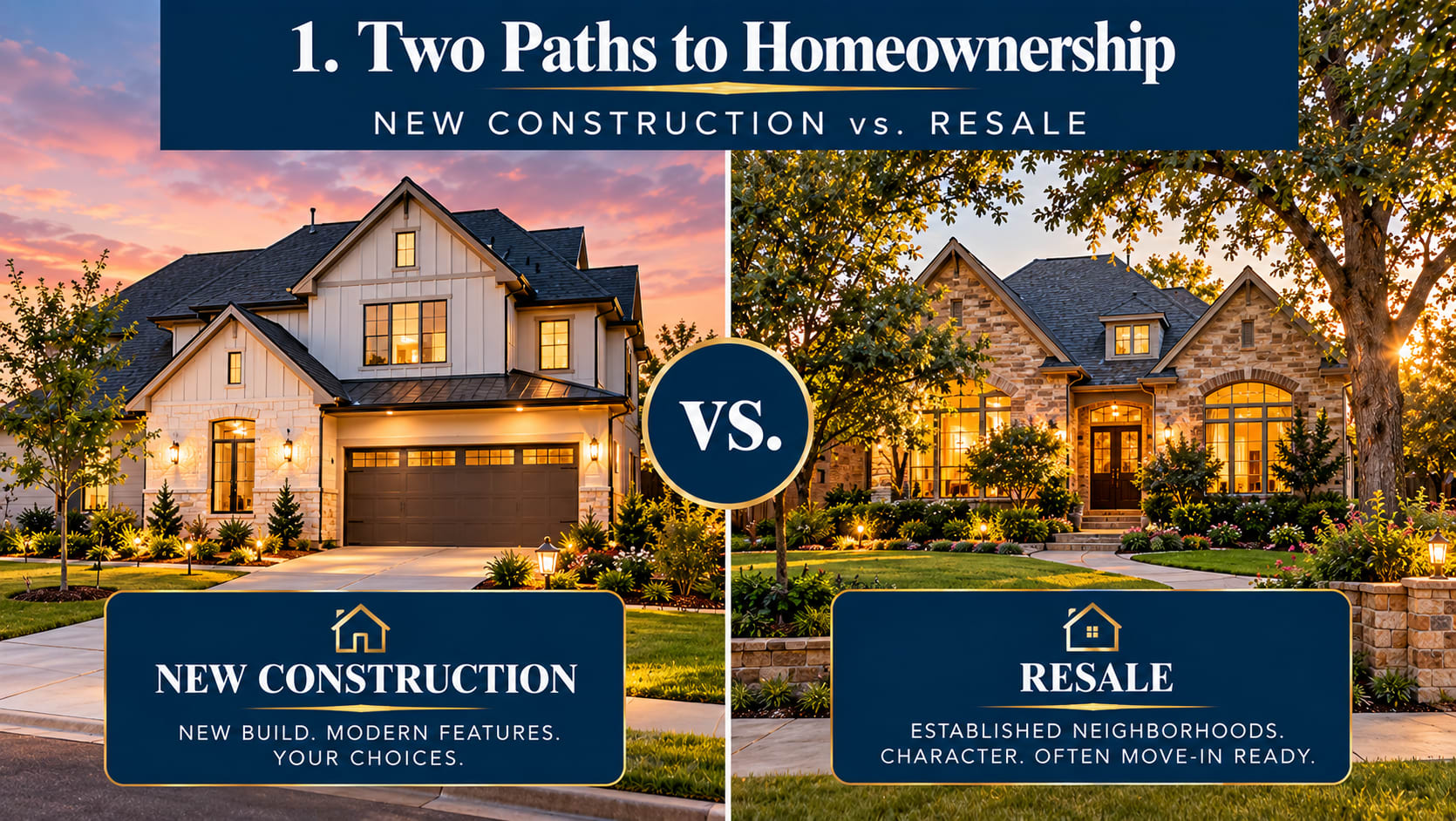

New Construction vs. Resale in North Texas
SECTION 1: THE QUESTION BUYERS SHOULD REALLY BE ASKING
The question isn't:
“Is new construction better than resale?”
The better question is:
“Which home gives me the best overall combination of cost, condition, location, risk and long-term value?”
That's an important distinction.
A $400,000 new construction home with a builder incentive could potentially have a lower initial payment. But similar opportunities can exist with a resale home, too. A buyer may be able to negotiate with the seller for a contribution toward an interest-rate buydown or other closing costs, depending on the transaction and loan program.
But the new home could also have higher property taxes, HOA costs or a PID/MUD assessment.
Meanwhile, the resale home might have a lower negotiated purchase price—but require an aging HVAC system to be replaced or significant updates to appliances, flooring or other major components within the first few years.
The sticker price doesn't tell the whole story.
SECTION 2: WHAT YOU'RE REALLY GETTING WITH NEW CONSTRUCTION
Let's start with the obvious: there are some pretty compelling reasons to consider a brand-new home.
When you buy new construction, you're generally starting with a new HVAC system, new appliances, modern building systems and a builder warranty. You may also get a more modern floor plan, better energy-efficiency features and, depending on how early you purchase, the opportunity to choose some of your finishes and selections.
But before you decide that “new” automatically means “better,” I want you to look a little deeper.
First, let's talk about the incentives.
If you've been looking at new construction, you've probably seen some pretty attractive offers.
You may see a builder advertising closing-cost assistance, a special interest rate, a rate buydown, design-center credits, upgrades or even a price reduction.
And I want you to pause before you get too excited about that headline number.
Ask yourself:
What does this incentive actually do for me?
Is the builder contributing toward your closing costs?
Are they buying down your interest rate?
Is the rate temporary or permanent?
Are they giving you money toward upgrades?
Are there restrictions on how the incentive can be used?
Do you have to use the builder's preferred lender or title company to receive it?
Those details can make a significant difference in the actual value of the offer.
For example, a temporary rate buydown could make your payment look very attractive during the first few years, but you need to know what your payment becomes after that period ends.
So don't just ask:
“How much is the builder giving me?”
Ask:
“What does this incentive actually save me over the life of my loan or during the time I expect to own the home?”
That's a much more useful question.
Now let's talk about what you're getting beyond the incentive.
One of the biggest advantages of buying new is that you're starting fresh.
You aren't walking into a home with a 10-, 15- or 20-year-old HVAC system and wondering how much longer it has.
You're not immediately wondering whether the appliances are nearing the end of their useful life.
That doesn't mean a new home won't require maintenance. Every home does.
But your timing can be very different.
If you're buying a resale home, you may need to budget for major components sooner. With new construction, you're generally starting with those components at the beginning of their useful life.
That can give you some additional predictability during those first few years of ownership.
Don't forget the warranty.
You're also typically getting some type of builder warranty with new construction.
But here's where I want you to do a little homework.
Don't simply hear “builder warranty” and assume everything is covered.
Ask:
What does the warranty cover?
How long does each type of coverage last?
Who do I contact if something goes wrong?
What isn't covered?
The answers can vary by builder, so read the actual warranty documents before you assume what protection you're receiving.
Now here's one of the questions I really want you to ask: What's actually included?
Before you fall in love with that beautiful model home, ask the builder for a written list of exactly what is included in the price—and what is going to cost you extra.
Because what you see in the model home isn't necessarily what you're getting at the base price.
Ask about the things you might assume are included:
Are the blinds included?
Is the refrigerator included?
What about the washer and dryer?
Are the garage door openers included?
And then go further.
Are the ceiling fans included?
What about the light fixtures?
Gutters?
Fencing?
Landscaping?
Sprinkler system?
Garage storage?
Even the appliances you see in the kitchen—range, oven, microwave, dishwasher and garbage disposal—should be confirmed.
I want you to get this information in writing.
Because here's what can happen otherwise.
You walk into a beautiful model home, you see the refrigerator, the gorgeous light fixtures, the blinds, the beautifully landscaped backyard and the finished garage, and you naturally assume those things are part of the house you're considering.
Then you get your final price and discover that some of those items were upgrades.
Suddenly, that $400,000 home isn't quite the same $400,000 home you thought you were comparing.
And that's exactly why we're going to compare move-in-ready cost, not just purchase price.
And then there's the upgrade trap.
If you're buying early enough in the construction process to choose finishes, this can be one of the most exciting parts of the experience.
You get to choose your flooring. Your countertops. Your cabinets. Your fixtures. Maybe your appliances. Maybe even structural options, depending on the builder and stage of construction.
But I want you to understand how those choices affect the overall price before you make them.
It's not about compromising on the things that matter to you. It's about knowing what you're choosing, what it costs, and how it fits into the overall purchase.
One more thing to understand: how the community can affect your equity.
There's another piece of the new-construction equation I want you to think about—your timeline.
If you're purchasing a home in the early phase of a subdivision that is planned to have multiple phases, take a close look at how long you realistically intend to stay.
Why?
Because if you decide to sell relatively soon, you may be competing directly with the builder.
If the builder is still selling brand-new homes in your community, that buyer may be able to purchase a brand-new house directly from the builder and receive incentives such as closing-cost assistance, interest-rate incentives, upgrades or other promotional offers.
Your resale home may not have access to those same incentives.
So even if your home has increased in value, the builder's remaining inventory can create additional competition when you go to sell.
And depending on the builder's pricing and incentives at that time, that competition can affect how much equity you've actually built—or how much of that equity you can realize when you sell.
Ask:
“If I needed to sell this home in two or three years, who would I be competing against?”
If the answer is “the builder is still selling new homes in my neighborhood,” that's important information to have before you purchase.
This doesn't mean you shouldn't buy in an early phase.
If you love the community, want the opportunity to choose your finishes, and plan to stay for several years, buying early may make perfect sense for you.
The important thing is to understand the relationship between your timeline, the community's build-out timeline and the builder's remaining inventory.
Before you purchase, find out:
How many total homes are planned?
How many phases are expected?
How many homes have already been built?
How many homes remain to be built?
How quickly is the builder releasing new inventory?
What incentives are currently being offered?
And what could that competition look like if you needed to sell before the community is complete?
Because when you're buying new construction, you're not just purchasing the house.
You're also purchasing into the timeline of the community.
And understanding that timeline can help you make a much more informed decision about your potential equity and your long-term plans.
And finally, look beyond the house.
When you're buying new construction, you're not just buying a house.
You're buying into a community that may not be finished yet.
So I want you to find out what the neighborhood is going to look like when it's complete—not just what it looks like the day you tour it.
How many homes are planned?
Are there future phases?
What amenities are planned?
When are the pool, trails, playgrounds or other amenities expected to be completed?
What's planned on the surrounding land?
Are there future roads or commercial developments nearby?
Because the empty field you see today may look very different three, five or ten years from now.
And that future development could affect your commute, traffic, amenities, property values and even the overall feel of the community.
And one more thing: please don't skip the inspection.
I don't care that the house is brand new.
New construction can have workmanship issues, incomplete items or systems that need adjustment.
An independent inspection gives you another set of eyes on one of the biggest purchases you're going to make.
Depending on the stage of construction, you may even want to consider inspections at different points during the build rather than waiting until the final walkthrough.
So yes, there are some very compelling reasons to consider new construction.
But I don't want you to buy something simply because the word “new” sounds appealing.
I want you to understand exactly what you're paying for, exactly what you're getting, exactly what the incentives are doing for you, what you're going to have to add after closing, and what the community around you is going to look like as it grows.
Because when we get to the end of this comparison, we're not going to ask you whether new construction is better than resale.
We're going to ask a much better question:
“Which home makes the most sense for you?”
SECTION 3: WHAT YOU'RE REALLY GETTING WITH RESALE
Now let's look at the other side of the equation: resale.
And sometimes resale gets treated like the “older option”—as if you're simply choosing an existing home because you couldn't or didn't want to buy new.
That's not the right way to look at it.
A resale home can offer some very real advantages, and depending on what matters most to you, those differences can be significant.
First, you're buying what you can actually see.
One of the biggest advantages of resale is that the house already exists.
You can walk through it.
You can see the finishes.
You can look at the backyard.
You can drive the neighborhood.
You can experience the traffic.
You can see the surrounding homes.
And you can get a much better sense of what you're actually buying.
With new construction, you're sometimes making decisions based on a model home, floor plans, renderings and a community that isn't finished yet.
With resale, you can see the real thing.
And that can give you a different kind of confidence when you're making your decision.
You're also buying into an established neighborhood.
With a resale home, the neighborhood may already be established.
The trees have had time to grow.
The landscaping is mature.
The streets are finished.
The amenities are typically already there.
And you can get a much clearer picture of what the community actually feels like—not what it's projected to become.
You can look around and ask:
Do I like this neighborhood?
Do I like the homes around me?
How busy is this street?
What does traffic look like in the morning?
What is the neighborhood like on a Saturday afternoon?
And if you're considering a home near a vacant piece of land, you can investigate what's actually planned for that property instead of assuming it will remain the open space you see today.
That's valuable information.
And then there's location.
One of the reasons you may consider resale is because the location you want may not have new construction available.
Maybe you want to be closer to work.
Maybe you want to be closer to family, restaurants, shopping or the activities that are already part of your life.
Maybe you love a particular established neighborhood where homes don't come on the market very often.
New construction can give you a brand-new house.
But resale can give you access to locations that are already established.
And sometimes that location, neighborhood and overall setting may matter more to you than having a brand-new home.
But here's where we need to look a little deeper.
Just because a resale home is less expensive than a comparable new home doesn't automatically mean it's going to cost you less.
This is where I want you to look beyond the purchase price.
When you're touring a resale home, pay attention to the age and condition of the major components.
How old is the HVAC system?
What about the water heater?
The appliances?
The windows?
The plumbing?
The electrical system?
And don't forget about the less obvious things.
Has the home had previous repairs?
Were there renovations?
Were those renovations permitted when required?
Are there signs of deferred maintenance?
None of these questions automatically make a resale home a bad choice.
In fact, some of these things can give you opportunities to negotiate.
But you want to know what you're buying.
This is where your inspection becomes extremely important.
With resale, an inspection can help you understand the condition of the home you're purchasing.
You may discover that the HVAC system is older but still functioning well.
You may discover that there are repairs or maintenance items you'll want to address.
And that's where the conversation becomes much more useful than simply saying, “This house is older.”
The better question is:
“What is the condition of this house today, and what expenses should I reasonably anticipate over the next several years?”
Because an older home that's been well maintained can have a very different ownership experience from an older home with deferred maintenance.
And then there's what's already here.
With a resale home, you're often buying a house that already has improvements and features in place.
The blinds may already be there.
The backyard may already be fenced.
The landscaping may already be established.
The sprinkler system may already be installed.
The garage door openers may already be there.
The home may already have ceiling fans, light fixtures, window treatments and other improvements.
And appliances are something you'll want to verify specifically.
The refrigerator may convey—or it may not.
The washer and dryer may convey—or they may not.
So don't assume.
Ask exactly what stays with the home and make sure it's clearly addressed in the purchase agreement.
That's important because when you're comparing a resale home with new construction, we're not really comparing $400,000 versus $400,000.
We're comparing what you actually receive for that $400,000.
And resale doesn't mean you can't negotiate.
With a resale home, the negotiation isn't necessarily limited to the purchase price.
Depending on the circumstances of the transaction, the seller may be willing to negotiate repairs, closing-cost contributions, concessions or other terms.
And in some situations, that could include a contribution toward an interest-rate buydown, subject to the loan program, lender requirements and the terms of the transaction.
So if you're looking at a resale home and thinking, “I wish I could get the payment closer to what that new-construction incentive would give me,” don't automatically assume the conversation is over.
There may be opportunities to structure the transaction differently.
That's something worth discussing with your lender and your real estate professional.
And then there's the potential for equity.
With a resale home, there can sometimes be an opportunity to purchase a property for less than its current market value.
Maybe the seller is motivated.
Maybe the home is priced strategically.
Maybe you're able to negotiate a favorable purchase price.
When that happens, you may have the opportunity to have equity in the property from the time you purchase it.
But that's a possibility, not a guarantee.
The amount of equity you have—and whether you have any equity immediately—depends on the property's actual market value, the price you pay, the market conditions and the specific circumstances of the transaction.
That's why this isn't about saying resale automatically gives you equity.
It's about recognizing that an existing home can sometimes provide an opportunity to purchase below market value in a way that may be different from buying directly from a builder.
And there's another advantage: you can see the finished product.
With new construction, you're sometimes buying into the future.
With resale, you're buying into something that already exists.
You can see the mature landscaping.
You can see the neighboring homes.
You can see how people actually use the community.
You can see the finished amenities.
You can see the traffic.
You can see the surrounding development.
And you can often get a much clearer picture of what daily life will actually feel like.
That doesn't mean resale is automatically better.
It simply means you're evaluating a different set of variables.
And sometimes the existing home has something you can't buy from a builder.
Maybe it's mature trees.
Maybe it's an established lot.
Maybe it's a particular architectural style.
Maybe it's a location within an established neighborhood.
Maybe it's a backyard that's already been landscaped.
Maybe it's a floor plan that isn't being built anymore.
Those things can have real value to you.
And if those features are part of what makes a house feel like home, they shouldn't be dismissed simply because the house isn't brand new.
So what should you take away from resale?
When you look at a resale home, don't just ask:
“How old is it?”
Ask:
“What am I actually getting?”
What's the condition of the major systems?
What's already been updated?
What's included in the sale?
What might need attention in the next few years?
What can potentially be negotiated?
What does the neighborhood actually look and feel like?
Could there be an opportunity to purchase the home below its current market value?
And what does this home offer that you can't get from a new-construction community?
Because just like with new construction, the goal isn't to convince you that resale is better.
It's to help you understand the full picture.
A resale home may come with older systems or components—but it may also come with an established neighborhood, a desirable location, existing improvements, visible surroundings and opportunities for negotiation.
And once you put all of those pieces on the table, you can make a much more meaningful comparison between the two.
Because the real question isn't “new or resale?”
It's:
“Which home gives me the combination of features, condition, location, cost and future expenses that makes the most sense for the life I want to live?”
SECTION 4: THE COST YOU DON'T SEE ON THE PRICE TAG
Now that we've looked at what you're getting with new construction and what you're getting with resale, let's talk about something that can completely change the comparison:
What is this home actually going to cost you?
Because the number on the sign is only the beginning.
Let's say you're comparing a $400,000 new construction home with a $400,000 resale home.
At first glance, it looks like an easy comparison.
They're both $400,000.
But they may not cost you the same amount to purchase, move into, or own.
So this is where I want you to slow down and look at the whole picture.
Start with the purchase price—but don't stop there.
With new construction, you may have a builder incentive that changes your upfront costs or monthly payment.
Maybe you're receiving closing-cost assistance.
Maybe there's a rate buydown.
Maybe you're getting upgrades included.
Maybe there's another builder promotion that changes the economics of the purchase.
With resale, you may have a different kind of negotiating opportunity.
The seller may be willing to contribute toward closing costs, negotiate repairs, offer a concession or, depending on the circumstances and loan program, contribute toward an interest-rate buydown.
So don't simply compare the advertised purchase prices.
Compare the actual terms of the two transactions.
Then look at the costs that follow you home.
What will your property taxes be?
What is the HOA?
Is there a PID or MUD assessment?
What will your homeowners insurance cost?
And what about the costs that don't show up in the purchase price?
If you're buying new construction, you may need to purchase items that aren't included in the base price.
Maybe the blinds aren't included.
Maybe the refrigerator isn't included.
Maybe you need a washer and dryer.
Maybe you'll need fencing, landscaping, a sprinkler system or garage door openers.
None of those things necessarily make the new home a worse value.
But they are part of your actual cost to make the home feel complete and ready for your life.
And that's why I want you comparing move-in-ready cost, not just purchase price.
Now look at the resale side.
With resale, some of those items may already be there.
But you may have another set of expenses to consider.
Maybe the HVAC system is older.
Maybe the water heater is approaching the end of its expected life.
Maybe the appliances are older.
Maybe the flooring or paint isn't what you would choose.
Maybe there are repairs you'd want to make before or shortly after moving in.
Again, that doesn't automatically make the resale home more expensive.
It simply means you need to understand what you're likely to spend after you buy it.
And remember, some of those items may become part of your negotiation with the seller, depending on the circumstances of the transaction.
But here's where I want you to go beyond the numbers.
There's another part of this decision that doesn't fit neatly into a spreadsheet.
Does this home fit the life you're living now—and the life you're planning for next?
Because your needs aren't necessarily going to stay the same.
Maybe you're a first-time buyer and this is your first opportunity to own a home.
Maybe you're buying a home for the next chapter of your life and want something that can grow with you.
Maybe you're planning to have more children and need additional bedrooms, a larger yard or more flexible living space.
Maybe your children are getting older and your needs are changing in a completely different direction.
Maybe you're looking for your forever home and want to think about how the home will serve you for many years.
Or maybe you're intentionally looking for a home that works for this stage of life, knowing that your next move may come later.
Those are very different goals.
And they can change how you evaluate the exact same house.
Think about your lifestyle, too.
It's not just about bedrooms and square footage.
Think about how you actually live.
Do you work from home?
Do you entertain?
Do you spend weekends outside?
Do you need a dedicated office?
Do you want a neighborhood with amenities?
Do you need to be close to family?
Is commute time important?
Do you want a larger lot?
Do you want low-maintenance living?
Do you want room for your family to grow?
Or are you entering a stage where you want less house and more simplicity?
The right home isn't just a home that fits your budget. It's a home that fits your life.
And then think about your future needs.
If you're planning to stay for five, ten or more years, what might your needs look like during that time?
Could your family grow?
Could your work situation change?
Could an aging parent eventually become part of your household?
Could your children need more space as they get older?
Could your lifestyle change?
You don't have to predict the future perfectly.
But you can ask whether you're buying a home that gives you enough flexibility for the future you're already anticipating.
And that's especially important when you're deciding whether to buy a home that works beautifully right now versus one that may give you more room to grow.
Now bring equity into the conversation.
And this is where your long-term goals matter, too.
You're not only buying a place to live.
You're also purchasing an asset.
So it's worth thinking about how the home may fit into your broader financial picture.
With resale, there may be opportunities to purchase below market value, depending on the property and circumstances.
With new construction, the community's development stage can affect your ability to build and realize equity, particularly if the builder is still competing with your home by selling new inventory.
Neither scenario guarantees a particular outcome.
But your time horizon matters.
If you're planning to stay for many years, you may evaluate the decision differently than if you think you may need to move in two or three years.
That's why I want you to think about your purchase in terms of both today and tomorrow.
Here's the comparison I want you to make.
Instead of asking:
“Which house has the lower price?”
Ask:
“What will it cost me to get each home to the point where it works for my life?”
Then take it one step further:
“Does this home work for where I am today, where I expect my life to be in the next several years, and the goals I'm working toward?”
And then:
“What might this home cost me—and potentially provide me—in years one through five?”
That's where the comparison becomes much more meaningful.
With the new construction home, maybe you're paying more upfront but getting a home that better accommodates your future plans.
With the resale home, maybe you're getting a location you love, an established neighborhood and improvements that are already in place.
Or maybe the opposite is true.
That's the point.
We're not trying to make one type of home win. We're trying to determine which home fits the life you're actually building.
So here's your real comparison.
When you're looking at a new construction home and a resale home, I want you to put these pieces next to each other:
Purchase price.
Financing and incentives.
Closing costs.
Property taxes.
HOA and applicable assessments.
Insurance.
What is included.
What you'll need to add.
Known repairs or updates.
Expected maintenance.
Your current lifestyle.
Your future needs.
Your expected time in the home.
Your potential for growth or changing needs.
And how the home fits into your longer-term goals.
Because sometimes the home that looks more expensive at the beginning may make more sense for the life you're planning.
And sometimes the home with the lower purchase price may require more investment—or simply may not fit where you're headed.
The goal isn't to find the cheapest home.
It's to understand the complete cost and determine whether the home makes sense for your life, your timeline and your goals.
Because the real question isn't:
“Which one is cheaper?”
It's:
“Which home gives me the right combination of cost, condition, location, lifestyle, future flexibility and long-term value for the life I'm building?”
SECTION 5: IS NOW THE RIGHT TIME TO BUY?
There's a question I hear all the time:
“Is now the right time to buy?”
And honestly, I don't think that question has a universal yes-or-no answer.
Because the right time to buy isn't determined by a headline about the economy.
It's determined by you.
Where are you financially?
Where are you in your life?
What are your goals?
How long do you expect to stay?
And does purchasing a home today move you toward the future you're trying to build?
Let's start with the question behind the question.
When you ask, “Is now the right time to buy?” what you're really asking is:
“Does buying a home make sense for me right now?”
Those are two very different questions.
There will always be something happening in the economy.
Interest rates will change.
Home prices will change.
Inventory will change.
The market will have stronger periods and slower periods.
If you wait for every market condition to be perfect, you may find yourself waiting indefinitely.
That's why I don't want you making this decision based solely on whether today's market feels good or bad.
I want you looking at your own situation.
Are you financially ready?
Start with the basics.
Do you have a stable source of income?
Do you understand what your complete monthly housing expense will be?
Are you comfortable with the down payment and closing costs?
Will you still have money available after closing for the unexpected things that come with owning a home?
Because buying a home isn't just about being able to qualify for the mortgage.
It's about being comfortable with the responsibility that comes after you get the keys.
And that's an important distinction.
A lender can tell you what you qualify for.
But only you can determine what feels comfortable for your life and your financial goals.
Then think about your time horizon.
How long do you realistically expect to live in the home?
If you're purchasing a home you expect to keep for many years, you may look at the decision differently than if you think you may move again in two or three years.
And if you're considering new construction in an early phase of a multi-phase community, remember what we talked about earlier.
If you need to sell while the builder is still selling brand-new homes, you're potentially competing with that inventory.
Your timeline matters.
What are you building toward?
What does owning this home help you accomplish?
Maybe you're a first-time buyer and you're ready to stop renting and begin building ownership.
Maybe you're growing your family.
Maybe you're looking for more space.
Maybe you're relocating.
Maybe you're looking for a home that can support your business or work-from-home lifestyle.
Maybe you're entering a new stage of life and want something different.
Maybe you're looking for your forever home.
There's no single definition of the “right” home or the “right” time.
Your goals matter.
And yes, equity matters.
When you purchase a home, you're not just paying for somewhere to live.
You're also purchasing an asset.
Over time, you may build equity through a combination of paying down your mortgage and changes in the home's market value.
But equity isn't guaranteed, and home values can go up or down.
That's why I don't want you buying a home simply because someone tells you that real estate is always a good investment.
I want you to understand what you're buying, why you're buying it, how long you expect to own it, and how that purchase fits into your larger financial picture.
So, is now the right time?
Maybe.
But the better question is:
“Is now the right time for me?”
If you're financially prepared, understand the costs of ownership, have a reasonable plan for how long you expect to stay, and the home supports the life you're building, those are meaningful factors to consider.
If you're not there yet, that's important information too.
Maybe you need more time to save.
Maybe you need more financial flexibility.
Maybe your life circumstances are changing.
Maybe you simply haven't found the right home yet.
Waiting doesn't mean you're failing.
And buying doesn't mean you've “won.”
They're simply different decisions based on where you are and where you're going.
Because there's always a reason to wait—and always a reason to move forward.
You can wait for rates to change.
You can wait for prices to change.
You can wait for more inventory.
You can wait for the “perfect” house.
But you can also recognize that there is value in beginning to build toward your future when the decision makes sense for you.
The important thing is not to let fear of getting the timing imperfect make the decision for you.
Instead, understand your numbers.
Understand your goals.
Understand your timeline.
Understand the home you're buying.
And then make the decision based on your reality—not somebody else's prediction about what the market will do next.
Because the goal isn't perfect timing.
It's making a housing decision that supports the life you're living and the direction you're growing.
SECTION 6: THE QUESTIONS YOU MAY NOT THINK TO ASK
Here's where I want to get really honest and personal.
Sometimes the hardest part of choosing a home isn't the numbers. It's the questions that don't immediately come to mind.
So before you make a decision, I want you to ask yourself—and investigate—some of the things that may not show up on a listing sheet or a builder's brochure.
What am I not seeing about this property?
What future development is planned around the home?
Are there future roads, commercial developments or additional phases that could change the area?
What will this neighborhood look like five years from now?
What about ten years from now?
If you're buying new construction, what is still being built?
If you're buying resale, what is planned around the existing neighborhood?
You don't just want to know what you're buying today.
You want to understand the environment you're buying into.
How convenient is this home to the life I actually live?
Not just your job.
Think about the places you actually go every week.
How far is it from your kids' school or activities?
How close are the softball fields?
How convenient is your favorite pickleball facility?
Are your favorite restaurants nearby?
How far is it from the places where you regularly meet friends?
Is the lake close if that's where you love spending your weekends?
Are the hiking trails you enjoy easy to get to?
What about shopping, entertainment, church, family or the other places that are part of your normal routine?
Because a home can look like an incredible value on paper, but if every part of your life requires a long drive, that's part of the lifestyle you're purchasing too.
What am I getting for the incentive?
If a builder is offering a significant incentive, or a seller is willing to contribute toward your transaction, ask yourself:
“If that incentive disappeared, would I still want this home?”
That's not about dismissing the incentive.
Incentives can be valuable.
It's about making sure the incentive isn't the only reason the property feels attractive.
Ask yourself what you're choosing in exchange for that financial benefit.
Are you farther from work?
Farther from family?
Farther from the activities you enjoy?
Farther from the restaurants, friends, lake or hiking trails that make your life feel like yours?
Maybe the trade-off is completely worth it to you.
Maybe it isn't.
The important thing is that you know you're making the trade-off.
How will this home feel five years from now?
It's easy to fall in love with a house when you're standing in it today.
But imagine your life five years from now.
Will the space still work?
Will the neighborhood still fit your lifestyle?
Will your commute still make sense?
Will your family have the space it needs?
Will the community have developed the way you expected?
Will you still love the location?
These questions don't have right or wrong answers.
They're simply questions that help you think beyond the excitement of the purchase.
What questions haven't I asked yet?
This may be the most important question of all.
Before you sign, ask your lender, builder, seller and real estate professional:
“What am I not asking that I should be?”
Sometimes the question you didn't know to ask is the one that gives you the information you needed most.
Because whether you're buying new construction or resale, you're not just choosing walls and a roof.
You're choosing how your life fits into that home.
You're choosing how much of your time you'll spend driving.
You're choosing what your weekends might look like.
You're choosing the community where you'll build memories.
And you're choosing a home that needs to support not just where you are today, but where you're heading next.
That's why these questions matter.
They're not about talking you into or out of a particular home.
They're about helping you see the whole picture before you make one of the biggest decisions of your life.
SECTION 7: CONCLUSION
In the end, this isn't about crowning a winner between new construction and resale.
It's about finding the home that actually fits your life, your budget, your timeline, and the direction you're going.
When you line up the costs, the conditions, the lifestyle fit, and the future flexibility, the question becomes:
“Which home supports the life I'm building?”
Not what's trendy.
Not what someone else prefers.
But the one that makes sense for you.
When you understand both paths clearly, you can choose with confidence and peace.
And that's the real win—a home that carries you forward instead of holding you back.